
Compliance Audits and Certification
Compliance audits and certification from IHIA help organizations demonstrate controlled operations, responsible management, ethical conduct, product integrity, and conformity with defined program requirements.
IHIA provides audit, evaluation, and certification programs for manufacturers, service providers, hospitality businesses, consumer-facing organizations, and other entities seeking independent assessment of their systems, products, practices, or claims.
Independent Assessment for Responsible and Controlled Operations
Organizations make many claims about the quality, safety, ethics, environmental impact, and integrity of their operations. Credible certification requires those claims to be supported by documented systems, effective controls, and verifiable evidence.
IHIA’s compliance audits and certification programs assess the areas relevant to the selected scheme and requested scope. Depending on the program, the assessment may examine management responsibilities, personnel, production controls, hygiene, sourcing, documentation, customer protection, environmental practices, product composition, labeling, claims, complaints, traceability, and operational consistency.
The exact scope is determined by the selected program, the organization’s activities, and the products, services, facilities, or locations included in the application.
Compliance Programs
click icons for details
GMP Certification
Good Manufacturing Practice certification assesses whether an organization maintains suitable controls over its production and operational environment.
The assessment may review premises, hygiene, personnel practices, equipment, documented procedures, production controls, storage, material handling, quality checks, sanitation, traceability, complaints, recalls, and the consistency of day-to-day operations.
GMP certification is relevant to organizations that need to demonstrate that products are manufactured, handled, and stored under controlled and appropriately managed conditions.
CSR Certification
Corporate Social Responsibility certification evaluates how an organization addresses responsible business conduct, ethical management, social accountability, and its responsibilities toward relevant stakeholders.
The assessment may consider governance, management commitments, employee-related practices, stakeholder communication, ethical conduct, community impact, accountability, documented responsibilities, and the organization’s approach to social and responsible business matters.
CSR certification helps an organization demonstrate that its commitments are supported by structured practices rather than broad or unsupported statements.
Customer Rights Certification
Customer Rights certification examines the systems used to protect customer interests and maintain fair, transparent, and responsible service practices.
The assessment may cover the clarity of customer information, contractual or service commitments, communication, complaint handling, response procedures, privacy and confidentiality controls, accessibility of support, corrective action, and management review of customer-related issues.
The purpose is to assess whether customer rights are understood, documented, implemented, and maintained throughout the service relationship.
Organic Certification
Organic certification assesses products, materials, sourcing, processes, handling practices, records, and claims within the scope requested by the applicant.
The review may include the origin of materials, supplier information, production and handling controls, segregation, storage, documentation, traceability, labeling, and the evidence used to support organic claims.
The applicable assessment criteria depend on the type of product, its supply chain, the processes involved, and the market in which the claim will be used.
Green Certification
Green certification evaluates an organization’s environmental practices and the evidence supporting its environmental claims.
The assessment may consider resource use, waste management, operational impacts, materials, sourcing, energy or water controls, environmental responsibilities, documentation, improvement measures, product information, and communication of green claims.
The certification scope is defined according to the organization, facility, product, service, or environmental claim being assessed.
Vegan Certification
Vegan certification assesses whether applicable products, materials, or services meet the defined requirements for a vegan claim.
The assessment may review ingredients, raw materials, processing aids, supplier documentation, manufacturing practices, shared facilities, contamination controls, storage, labeling, traceability, and the evidence supporting the absence of animal-derived inputs.
Certification applies only to the approved products, materials, processes, or services included in the certification scope.
Animal-Free Certification
Animal-Free certification assesses products, materials, processes, or claims that require confirmation that animal-derived inputs are not used within the approved scope.
The review may include material composition, supplier records, processing aids, production practices, shared equipment, segregation, documentation, traceability, labeling, and control of changes that could affect the claim.
The scope must clearly identify what is being certified and the specific products, processes, materials, or facilities covered.
Islamic Hotel Evaluation
Islamic Hotel Evaluation reviews hospitality facilities and services against defined Muslim-friendly and Islamic service requirements.
The evaluation may cover:
- Premises and guest facilities
- Prayer times and Qiblah information
- Prayer areas or Musolla
- Ablution facilities
- Washrooms
- Halal food and dining services
- Services during Ramadan
- Guest privacy
- Health, wellness, and recreational facilities
- Personnel awareness
- Cleaning and operational controls
- Applicable legal requirements
The evaluation scope depends on the services and facilities the hotel, resort, serviced apartment, or other hospitality provider wishes to include. The original presentation identifies prayer arrangements, ablution facilities, Halal food, Ramadan services, dining areas, personnel, cleaning, wellness facilities, and a Muslim-friendly hospitality rating approach as relevant assessment areas.
Compliance Audits and Certification Assessment Areas


The following areas may be reviewed depending on the selected program.

Management & Responsibilities
Organizational roles, policies, management commitments, authority, accountability, and oversight of the applicable program.
Documentation & Records
Policies, procedures, specifications, supplier records, operational records, complaints, corrective actions, traceability, and supporting evidence.
Personnel & Competence
Cleaning, sanitation, pest control, personnel hygiene, contamination prevention, equipment cleanliness monitoring, and the suitability of the operating environment.
Materials & Suppliers
Raw materials, ingredients, components, sourcing, supplier approval, specifications, supporting certificates, and purchasing controls.
Processes & Facilities
Production, service delivery, equipment, premises, storage, handling, operational controls, maintenance, and consistency of implementation.
Hygiene & Operational Control
Responsibilities, awareness, training, competence, supervision, conduct, role-specific authorization and oversight, and implementation of required practices.
Labeling & Communication
Product labels, environmental or ethical claims, customer information, promotional statements, certification marks, and public communication.
Complaints & Improvement
Complaint handling, nonconformities, corrective actions, internal review, monitoring, recalls where applicable, and continuous improvement.
How Compliance Audits and Certification Work

1. Application
The organization submits its company details, selected program, activities, locations, and requested certification or evaluation scope.
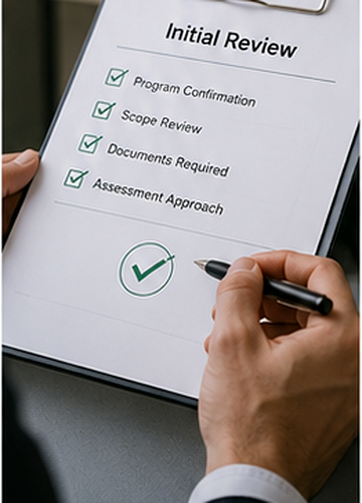
2. Initial Review
The applicant receives information about the proposed scope, required documents, assessment stages, and quotation.

3. Proposal & Preparation
The applicant receives information about the proposed scope, required documents, assessment stages, and quotation.

4. Document Review
Relevant policies, procedures, product information, supplier evidence, records, labels, claims, and supporting documents are reviewed.

5. Audit or Evaluation
IHIA assesses the applicable facilities, processes, personnel, systems, products, or services against the defined program requirements.

6. Findings & Corrective Actions
Any identified nonconformities or required corrections must be addressed and supported with suitable evidence.
7. Review & Decision
The assessment results and corrective-action evidence are reviewed before the certification or evaluation decision is made.
8. Ongoing Compliance
Surveillance, renewal, follow-up evaluation, or review of changes may be required to maintain certification.
Who can apply?
Programs for Products, Services and Organizations
Applications may be submitted by:
- Manufacturers and processors
- Food and consumer-product companies
- Cosmetics and personal-care businesses
- Hotels, resorts and hospitality providers
- Retailers and service organizations
- Organizations seeking GMP assessment
- Companies seeking CSR certification
- Businesses making Organic, Green, Vegan or Animal-Free claims
- Organizations seeking Customer Rights certification
- Other entities requiring a defined compliance audit or evaluation
Choosing the right program
Which Compliance Program Do You Need?
- GMP Certification
- CSR Certification
- Customer Rights Certification
- Islamic Hotel Evaluation
- Other programms
Choose GMP Certification when the main concern is controlled production, hygiene, personnel practices, equipment, documentation, storage, and operational consistency.
Choose CSR Certification when the organization needs assessment of responsible business conduct, ethical management, social accountability, and stakeholder responsibilities.
Choose Customer Rights Certification when the focus is customer protection, transparent communication, complaint handling, and fair service practices.
Choose Islamic Hotel Evaluation when a hospitality facility needs its Muslim-friendly services, facilities, and operating practices evaluated.
Choose Organic, Green, Vegan, or Animal-Free Certification when a product, material, process, or claim requires independent assessment and supporting evidence.
Frequently Asked Questions
Yes. Where relevant, an organization may request assessment under more than one program. Each scope and applicable requirement will be reviewed separately.
Certification applies only to the products, services, facilities, processes, or locations included in the approved scope.
The assessment method depends on the selected program and requested scope. An on-site audit or evaluation may be required where facilities, processes, services, or operating controls must be assessed directly.
The requirements vary by program. Documents may include company information, procedures, product or material specifications, supplier records, labels, operational records, complaint records, environmental information, and evidence supporting relevant claims.
The timeframe depends on the program, scope complexity, number of products or sites, document readiness, audit availability, and the time required to address findings.
Yes. Applicants may select “Not sure / Need guidance” and describe their activities and objectives for an initial review.
